
This post may contain affiliate links. Please read our disclosure policy.
This was my first time dry-brining a turkey and I don’t think I’ll ever look back. It’s so much easier than a traditional wet brine and quite possibly even more delicious. Here’s how to make my Dry-Brine Thanksgiving Turkey!
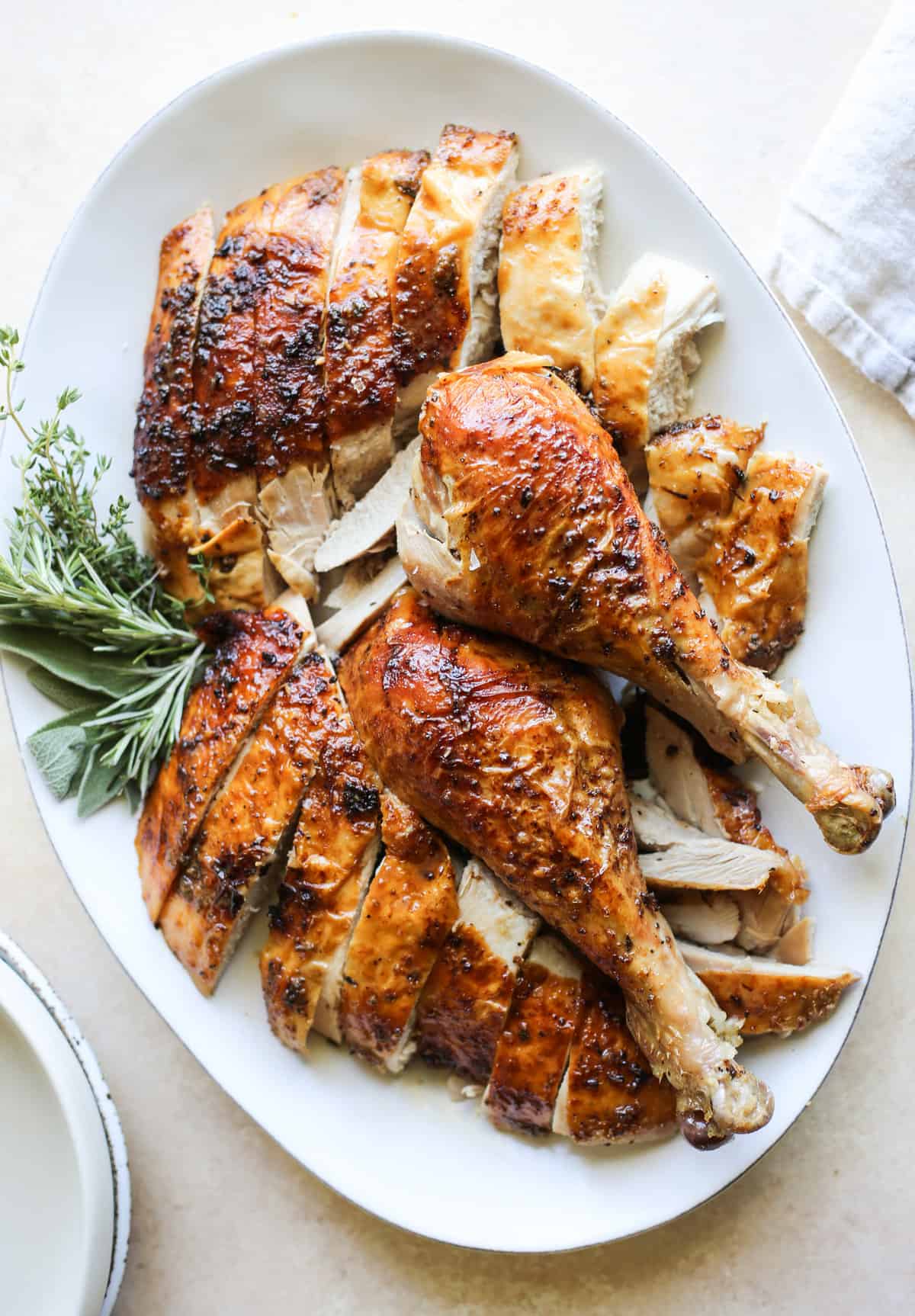
As we all know, Thanksgiving turkey can often get a bad rep. Flavorless, overcooked, dry…it can really go bad pretty quickly. Enter: dry-brining! This technique not only helps inject the turkey with flavor, but also helps it to stay super moist.
To do it, you’ll rub a salt and dry spice mixture all over the turkey, then let it sit for 24 to 48 hours in the fridge. As it rests, the salt helps to draw out the meat’s juices, then the salt dissolves into the juices, creating a brine without adding any liquid. From there, the brine soaks into the meat resulting into a flavorful, moist turkey.
There’s a few important things to keep in mind as you prep your bird. If you buy a frozen turkey, make sure you give it plenty of time to defrost. I’d allocate 3 to 4 days for your turkey to thaw in the fridge, depending on the size. Once your turkey is thawed, let it dry brine for 1 to 2 days before Thanksgiving. On Thanksgiving Day, remove it from the fridge for 1 to 2 hours prior to roasting so that it roasts more evenly and has a better chance at developing perfectly crispy skin, which everyone loves.
ingredients:
- Kosher Salt
- Fresh Sage
- Fresh Rosemary
- Fresh Thyme
- Garlic Cloves
- Freshly Ground Black Pepper
- Light Brown Sugar
- Cayenne Pepper
- Lemon Zest
- Turkey
- Low-Sodium Chicken Broth
- Unsalted Butter
step-by-step:
step one: make the dry rub
In a small mixing bowl, whisk together the salt, brown sugar, sage, rosemary, thyme, garlic, black pepper, cayenne pepper, and lemon zest.
step two: prep the turkey
Pat the turkey dry with paper towels. Arrange a roasting rack on a large sheet pan and place the turkey on top of the rack.
step three: dry brine the turkey
Rub the dry brine all over the turkey, especially on the breasts. Refrigerate, uncovered, for 24 to 48 hours.
step four: get ready to roast
Remove the turkey from the fridge to let stand for 1 hour at room temperature before roasting. Meanwhile, preheat the oven to 425°F.
step five: butter the turkey
Working from the neck end of the turkey, gently loosen the skin from breasts and rub the softened butter under skin of the bird. Tie the legs together with kitchen twine.
Fill a roasting pan with the broth and place the turkey and rack in the roasting pan. Transfer to the oven and roast until the skin starts to brown, about 20 minutes.
step six: roast the turkey
Reduce the oven temperature to 325°F and continue roasting, basting the turkey every 20 to 30 minutes with the broth/juices from the turkey.
When the turkey is starting to look golden brown all over, tent with foil. Continue to roast the turkey until an instant-read thermometer inserted into the thickest part of the thigh (without touching bone) registers 160°F. It will continue to cook once you remove it from the oven.
step seven: carve and serve
Let the turkey rest for 20 to 30 minutes before carving and reserve any pan juices for my Herby Turkey Gravy.
No! That’s the beauty of a dry brine. It’s way less messy than a wet brine. For a dry-brined turkey, you don’t need to rinse the brine off since it will retain great flavor as it roasts. Instead, simply brush off any excess salt before cooking.
You should account for about 1½ pounds per person, which will be enough to feed a crowd and offer leftovers. If you’re hosting 10 people, you’ll want to buy a turkey that is about 15 pounds.
Follow these tips and and you will have a perfectly cooked Dry-Brined Thanksgiving Turkey that you’ll want to make for years to come! Oh, and don’t forget to pair it with my Herby Turkey Gravy!
looking for more Thanksgiving recipes? try these!
Dry-Brine Thanksgiving Turkey
Ingredients
For the Dry Rub:
- 1/4 cup kosher salt
- 3 tablespoons light brown sugar
- 2 tablespoons minced fresh sage leaves
- 1 tablespoon minced fresh rosemary leaves
- 1 tablespoon minced fresh thyme leaves
- 4 garlic cloves, minced
- 2 teaspoons freshly ground black pepper
- ½ teaspoon cayenne pepper, optional
- 2 tablespoons lemon zest (from 2 small lemons)
For the Turkey:
- 1 (12- to 18-pound) turkey
- 2 cups low-sodium chicken broth, plus more as needed
- 6 tablespoons unsalted butter, softened
Instructions
- In a small mixing bowl, whisk together the salt, brown sugar, sage, rosemary, thyme, garlic, black pepper, cayenne pepper, and lemon zest.
- Pat the turkey dry with paper towels. Arrange a roasting rack on a large sheet pan and place the turkey on top of the rack.
- Rub the dry brine all over the turkey, especially on the breasts. Refrigerate, uncovered, for 24 to 48 hours.
- Remove the turkey from the fridge to let stand for 1 hour at room temperature before roasting. Meanwhile, preheat the oven to 425°F.
- Working from the neck end of the turkey, gently loosen the skin from breasts and rub the softened butter under skin of the bird. Tie the legs together with kitchen twine.Fill a roasting pan with the broth and place the turkey and rack in the roasting pan. Transfer to the oven and roast until the skin starts to brown, about 20 minutes.
- Reduce the oven temperature to 325°F and continue roasting, basting the turkey every 20 to 30 minutes with the broth/juices from the turkey.When the turkey is starting to look golden brown all over, tent with foil. Continue to roast the turkey until an instant-read thermometer inserted into the thickest part of the thigh (without touching bone) registers 160°F. It will continue to cook once you remove it from the oven.
- Let the turkey rest for 20 to 30 minutes before carving and reserve any pan juices for my Herby Turkey Gravy.
Notes
Nutrition
Nutrition information is automatically calculated, so should only be used as an approximation.


Any idea what cook times would be for a turkey breast?? Excited to try!
Can I use this and follow the cook times on your spatchcocked turkey recipe? I love this dry brine but want to try a spatchcocked turkey!
Do I rub the dry brine under the skin? Or on top of the skin?
You rub it on top of the skin!
Can you spatchcock the turkey? Is that necessary or would it change how it cooks?
You definitely could, but it would change the cook time (spatchcock turkeys usually cook in about an hour to an hour and a half, depending on the time)
It won’t be too salty will it?
I don’t find it too salty and everyone that makes this recipe raves about it!
Hi! I’m going to try this dry brine, but my turkey is a 24-28 pounder. How much should I increase each ingredient for the brine? Thank you!
That’s a big bird! haha. I would double the dry brine! then you could just brush off the excess salt combination before roasting.
hi alex,
If I bought a pre brined turkey, can I still use this recipe or is there an easy way to modify it? thx!
I worry if it is already pre-brined, brining it again make make it overly salty. I would just crust it with a herby salt blend (less than what I call for in the dry brine) so that the skin is seasoned, and then stuff some butter under the skin.
Hi Alex! I’m hosting a friendsgiving on Friday but trying to figure out if there’s any way I can cook the turkey ahead of time on Thursday night. Is that possible to still have it taste delish on Friday by just reheating?
yes you could definitely do this. I would cook the turkey, carve it and save any pan juices to pour on top to keep it nice and moist. Refrigerate. Reheat on Friday: reheat the turkey in a 325°F oven. Keep it covered with foil and baste it with the juices occasionally. If it’s looking a little dry, add a splash of chicken broth or stock. Should take 20-30 minutes.
Would coconut or maple sugar work for the rub?
I find it burns/tastes burns more quickly with coconut sugar, I haven’t tried Maple Sugar!
I’m going to try your recipe.
Do you wipe off the dry brine ingredients before roasting? Thanks
For a dry-brined turkey, you don’t need to rinse the brine off since it will retain great flavor as it roasts. Instead, simply brush off any excess salt before cooking.